
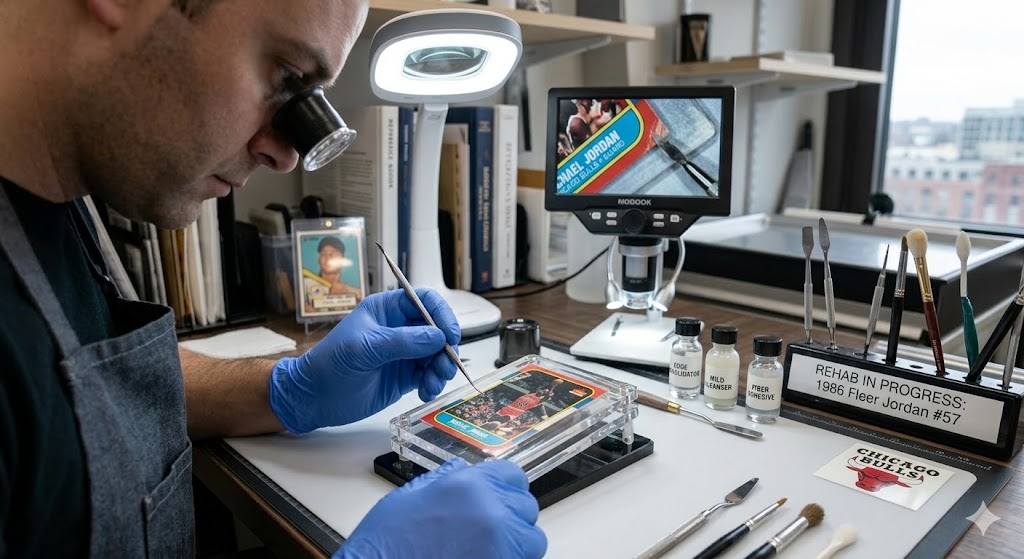
Proven techniques for cleaning, handling, and preparing cards without triggering authentication flags
Learn the exact preservation methods that protect your cards’ originality while maximizing grade potential. This guide covers safe cleaning protocols, proper handling techniques, and storage practices that grading companies approve.
TL;DR
- Preservation protects, restoration alters – Grading companies accept methods that prevent damage but penalize attempts to repair existing defects or modify card characteristics.
- Assessment comes first – Document every card’s condition with photographs and magnified inspection before any preservation work begins.
- Environmental control prevents most damage – Stable temperature (65 to 72°F), controlled humidity (40 to 50%), and archival materials matter more than cleaning techniques.
- Less cleaning is usually better – Compressed air and soft brushes only. Aggressive cleaning creates more defects than it removes, and graders detect residue and micro-scratches.
- Corners and edges lose the most points – Develop handling habits that avoid contact with these areas, and inspect sleeves before every card insertion.
Guide Orientation: What This Guide Covers
This guide teaches you how to preserve card authenticity during restoration, a critical skill that directly impacts your grades and resale value. You will learn specific techniques for cleaning, handling, and preparing cards without compromising their original characteristics.
This content is designed for sports card collectors and TCG enthusiasts who want to maximize their cards’ potential before professional grading. By the end, you will understand the boundaries between acceptable preservation and alterations that trigger authentication flags.
We cover physical cleaning methods, surface treatments, and storage protocols. We do not cover chemical alterations, pressing techniques that modify card structure, or any method that grading companies classify as tampering.
Why Card Preservation Matters Now
The grading market has fundamentally shifted. 26.8 million cards were graded in 2025 , a 32% increase from the previous year. This surge means grading companies scrutinize submissions more carefully than ever, and authentication failures cost collectors both time and money.
Poor preservation choices create permanent problems. A card with surface contamination might grade PSA 7 instead of PSA 9, representing a potential value difference of hundreds or thousands of dollars depending on the card. Worse, aggressive cleaning attempts can leave micro-scratches or chemical residue that authentication experts detect immediately.
Non-sports and TCG card grading increased 95% in 2025 , with collectors prioritizing condition, authentication, and long-term preservation. This trend confirms that the market rewards proper card care. Collectors who understand preservation techniques gain a measurable advantage in both grading outcomes and resale negotiations.
The cost of inaction compounds over time. Dust accumulates, oils transfer from handling, and improper storage causes gradual degradation. Each day without proper preservation protocols reduces your cards’ potential.
Core Concepts: Understanding Authenticity in Card Preservation
What Graders Actually Evaluate
Authenticity assessment examines whether a card remains in its original manufactured state. Graders look for evidence of trimming, re-coloring, cleaning residue, and surface alterations. Understanding these evaluation criteria helps you avoid preservation methods that trigger red flags.
The Preservation vs. Restoration Distinction
Preservation maintains current condition and prevents future damage. Restoration attempts to return a card to a previous state. Grading companies accept preservation but penalize or reject restoration. This distinction matters because many collectors unknowingly cross the line.
Acceptable preservation includes removing loose surface debris, proper storage, and careful handling. Problematic restoration includes pressing out creases, filling surface scratches, and color touch-ups. The boundary is clear: you can protect what exists, but you cannot recreate what was lost.
Common Misconceptions
Many collectors believe that professional cleaning always improves grades. In reality, improper cleaning creates new defects more often than it removes existing ones. Others assume that graders cannot detect subtle alterations. Modern authentication uses magnification, UV light, and surface analysis that reveals most tampering attempts.
The safest approach treats preservation as damage prevention rather than damage repair.
The Authenticity-First Preservation Framework
Effective card preservation follows a four-phase system: Assessment, Protection, Maintenance, and Preparation. Each phase builds on the previous one, creating a complete approach that maximizes grades without risking authenticity flags.
Assessment determines your card’s current state and identifies specific preservation needs. Protection implements storage and handling protocols that prevent new damage. Maintenance addresses ongoing care requirements. Preparation readies cards for grading submission with final inspection and documentation.
These phases interconnect continuously. Assessment informs protection choices, maintenance reveals new assessment needs, and preparation validates your entire preservation approach. Think of this as a cycle rather than a linear process.
Step-by-Step Breakdown
Step 1: Comprehensive Card Assessment
Objective: Document your card’s current condition with precision before any preservation work begins.
Start with proper lighting. Use a bright, diffused light source positioned at multiple angles. Natural daylight works well, but avoid direct sunlight that can cause additional fading. Examine both the front and back surfaces systematically.
Use a jeweler’s loupe (10x magnification minimum) to inspect corners, edges, and surface details. Document what you find with photographs. This documentation serves two purposes: it guides your preservation decisions and creates a record that proves you did not alter the card.
Grade the card yourself using PSA, BGS, or SGC standards before proceeding. This baseline assessment helps you set realistic expectations and identify which defects are addressable through legitimate preservation.
What to avoid: Do not handle cards with bare hands during assessment. Do not rush this phase, as missed defects lead to poor preservation choices. Do not assume you know a card’s condition without magnified inspection.
Success indicators: You have clear photographs of all surfaces, a written list of observed defects, and a preliminary grade estimate based on grading company standards.
Step 2: Environmental Protection Setup
Objective: Create storage conditions that halt degradation and prevent new damage.
Temperature stability matters more than specific temperature. Aim for 65 to 72 degrees Fahrenheit with minimal fluctuation. Rapid temperature changes cause expansion and contraction that stress card materials. Humidity should stay between 40% and 50% relative humidity.
Invest in archival-quality supplies. Penny sleeves should be acid-free polypropylene. Top loaders should be PVC-free. For high-value cards, consider one-touch magnetic holders with UV protection. CGC graded a record 341,000 cards in April 2025 , indicating that more collectors than ever are preparing cards for professional evaluation, and proper storage is the foundation.
Store cards vertically in boxes designed for the purpose. Horizontal stacking creates pressure points. Keep storage away from exterior walls, windows, and HVAC vents where temperature and humidity fluctuate most.
What to avoid: Do not use rubber bands, paper clips, or tape anywhere near cards. Do not store cards in basements, attics, or garages. Do not place cards in direct contact with cardboard that may contain acids.
Success indicators: A hygrometer confirms stable humidity, cards are individually sleeved in archival materials, and storage location maintains consistent conditions.
Step 3: Safe Surface Cleaning
Objective: Remove loose surface contamination without creating new defects or leaving residue.
Work in a clean, well-lit environment with minimal air movement. Wear nitrile gloves (not latex, which can leave residue). Have your supplies ready before beginning: a soft camel hair brush, microfiber cloth, and compressed air canister.
Start with the least invasive method. Use compressed air from 6 to 8 inches away at an angle to remove loose dust. Short bursts prevent moisture buildup from the propellant. For stubborn particles, use the camel hair brush with light, directional strokes.
Never use water, alcohol, or any liquid on vintage cards. Modern cards (post-2000) with glossy finishes can tolerate a barely damp microfiber cloth for fingerprint removal, but this carries risk. When in doubt, stop. A dusty card grades better than a card with cleaning damage.
What to avoid: Do not rub surfaces aggressively. Do not use erasers, even those marketed for card cleaning. Do not attempt to remove stains, writing, or embedded debris, as these require professional assessment.
Success indicators: Surface debris is removed, no new scratches visible under magnification, and no residue or moisture present.
Step 4: Edge and Corner Protection
Objective: Prevent the most common grading deductions through proper handling and storage techniques.
Corners and edges account for the majority of grade reductions. These areas are vulnerable during every interaction with the card. Develop handling habits that minimize contact with these zones.
When moving cards, grip them by the center of opposite edges using minimal pressure. Never slide cards across surfaces. Lift vertically, move horizontally, place vertically. This three-step motion prevents edge contact with sleeves, holders, and other cards.
Inspect sleeve openings before insertion. A rough edge on a penny sleeve can cause corner damage during a single insertion. Replace any sleeve that shows wear. For valuable cards, consider using sleeve protectors or double-sleeving with the inner sleeve inverted.
What to avoid: Do not force cards into tight-fitting holders. Do not stack unsleeved cards. Do not handle cards when distracted or rushed.
Success indicators: No new corner or edge wear appears after handling, cards slide smoothly into sleeves without resistance, and you can handle cards confidently without touching corners.
Step 5: Documentation and Tracking
Objective: Maintain records that support authenticity claims and track condition changes over time.
Create a simple tracking system for each card you intend to submit for grading. Include purchase date, purchase source, condition at acquisition, and any preservation work performed. Photograph cards at each stage.
This documentation serves multiple purposes. It helps you identify which preservation methods work best for your collection. It provides evidence of provenance if authenticity questions arise. It also helps you make informed decisions about when to submit cards for grading.
Track market conditions alongside card conditions. A card’s optimal submission timing depends on both its physical state and current market demand. Your records should support both preservation decisions and business decisions.
What to avoid: Do not rely on memory alone. Do not skip documentation for lower-value cards (they may appreciate). Do not store records only on devices that could fail.
Success indicators: Every card has a documented history, photographs clearly show condition at each stage, and you can quickly retrieve information about any card in your collection.
Step 6: Pre-Submission Preparation
Objective: Ready cards for grading submission with final inspection and proper packaging.
Conduct a final assessment 24 to 48 hours before submission. This gap allows you to catch issues with fresh eyes. Compare current condition to your initial documentation. Note any changes and determine if they affect your grade expectations.
Clean your workspace and supplies. A single dust particle trapped in a submission holder can cause surface scratching during transit. Use fresh sleeves and holders for final packaging. Inspect each one before use.
Package cards according to grading company specifications exactly. PSA, BGS, and SGC each have specific requirements. Deviations can delay processing or cause handling damage. Include all required documentation and verify submission forms match your actual cards.
What to avoid: Do not rush final preparation. Do not reuse sleeves or holders from previous submissions. Do not deviate from grading company packaging requirements.
Success indicators: Cards match documentation, packaging meets grading company standards, and you have confidence in your grade expectations based on thorough assessment.
Common Mistakes and Pitfalls
The most frequent error is over-cleaning. Collectors see a minor surface issue and attempt to fix it, creating worse problems. A light fingerprint often grades better than the micro-scratches from aggressive cleaning attempts. When preservation work makes things worse, you cannot undo the damage.
Impatience causes preventable losses. Rushing through assessment misses defects. Forcing cards into holders damages corners. Submitting without proper preparation wastes grading fees on cards that needed more work.
Many collectors underestimate environmental damage. A card stored in good conditions for years can degrade in weeks when moved to a humid basement or hot attic. Preservation is not a one-time activity but an ongoing commitment.
Finally, some collectors attempt restoration techniques they learned online without understanding the risks. Grading companies employ experts who have seen every alteration method. The consequences of detected tampering extend beyond a single card to your reputation as a seller.
What to Do Next
Start with assessment. Choose five cards from your collection and document their current condition using the methods described above. This single action builds the foundation for everything else.
Do not attempt to implement every technique immediately. Sustainable preservation habits develop through repetition, not intensity. Master proper handling before attempting surface cleaning. Establish storage protocols before worrying about pre-submission preparation.
Return to this guide as a reference when preparing specific cards for submission. The framework remains consistent, but each card presents unique considerations. Your skills will improve with practice, and your grades will reflect that improvement.
For collectors who want professional support with card preparation and grading submission, Graden Cards offers meticulous in-house rehabilitation and flexible service tiers designed to maximize grades while maintaining complete authenticity.
Frequently Asked Questions
How do I know if a cleaning method is safe for my card?
Test any cleaning method on a low-value card of similar age and finish first. If you see any surface change under magnification, do not use that method on valuable cards. The safest approach uses only compressed air and soft brushes. Liquid cleaning carries significant risk for any card printed before 2000.
Will grading companies detect if I pressed a card to remove creases?
Yes. Professional graders examine cards under magnification and specific lighting conditions that reveal pressing evidence. Pressed cards often show fiber disruption, surface texture changes, or unnatural flatness. Detection typically results in a “cleaned” or “altered” designation that significantly reduces value.
How long can I store cards before condition degrades?
With proper storage (stable temperature, 40 to 50% humidity, archival materials, no light exposure), cards can maintain condition for decades. Without proper storage, noticeable degradation can occur within months. The key factors are environmental stability and material quality, not time alone.
Should I remove cards from original packaging for preservation?
This depends on the packaging. Factory-sealed products often have preservation value that exceeds the cards inside. For loose cards in non-archival materials (old cardboard boxes, rubber-banded stacks), transfer to proper storage immediately. Document the original storage state before making changes.
What is the difference between PSA, BGS, and SGC authentication standards?
All three companies reject altered cards, but their detection methods and tolerance levels vary slightly. PSA tends to be strictest on vintage cards. BGS provides sub-grades that can reveal specific concerns. SGC has built a reputation for consistency with vintage material. Choose based on your card type and target market.
How much does proper preservation actually affect resale value?
A single grade point difference typically represents 20% to 50% value change for common cards and can mean thousands of dollars for key cards. Proper preservation protects existing grade potential and prevents the gradual decline that occurs with poor storage. The return on preservation investment is substantial for any card worth grading.